
EX File Manager
v1.6.0.4
• Unlocked
| Updated On | |
|---|---|
| Google Play ID | ru.gavrikov.mocklocations |
| Category | Tools |
| Version | 1.37.4 |
| Size | 38 MB |
| MOD Features | Unlocked |
| Requires | Android 7.0 |
| Price | |
| Free | |
| Content Rating | |
| Mature 17+ | |
| Internet Required | |
| Unknow | |

Mock Locations (fake GPS path) is an Android utility designed for users who need to simulate GPS movement along a planned route. Instead of reporting only a fixed location, the app can create a virtual path and move the device location along that route. This makes it useful for testing location-based applications, checking how software responds to movement, or experimenting with map features without physically traveling. Its route-based approach gives users more control than a simple static location changer, while Android’s location permissions and developer settings remain important for proper operation.
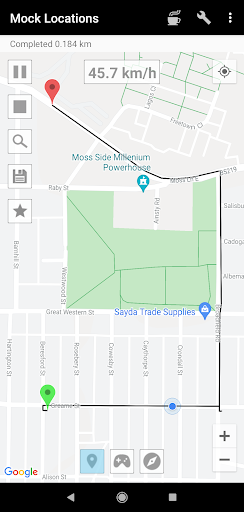
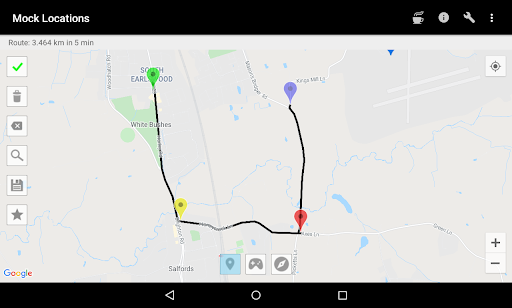
Mock Locations (fake GPS path) focuses on simulated location movement rather than ordinary navigation. Users can define a starting point, select destinations, and create a virtual route between them. The device can then report changing GPS coordinates according to the simulated movement. This can be helpful for developers, testers, and users who want to understand how location-dependent features behave under different movement conditions.
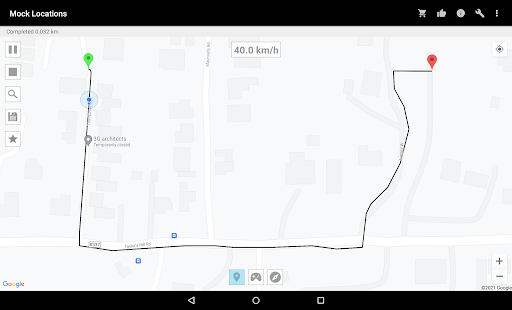
The main attraction is the ability to create a fake GPS path instead of keeping the phone at one simulated point. A route can represent movement between multiple locations, allowing applications to receive a sequence of changing coordinates. Depending on the available controls, users can adjust the movement pattern to create a more realistic testing scenario.
Location simulation can help test applications that depend on geographical data. Developers may use a virtual route to check map markers, tracking functions, distance calculations, or location-triggered interfaces. This is particularly convenient when testing several locations would otherwise require repeated physical travel. The results can also help identify how an application behaves when GPS data changes continuously.
The app provides a focused environment for working with simulated coordinates. Rather than acting as a replacement for a navigation service, it works with Android’s location system to provide test data. The actual experience can depend on Android version, device configuration, and whether the target application accepts mock location information.
Creating a route gives users greater flexibility than choosing a single fixed location. A virtual journey can include different points and directions, making it possible to reproduce scenarios involving movement. This is useful when checking how an application handles changing positions, route progress, or distance-related information. A carefully prepared path can also make repeated tests more consistent.
For reliable operation, users need to configure Android’s developer options and mock location settings correctly. Permissions may also affect how location data is delivered. If another application does not react as expected, checking these settings is an important first step. Battery optimization, background restrictions, and Android security changes may also influence continuous location simulation.
Start by installing the application and reviewing its available location permissions. Android may require users to enable Developer Options before selecting a mock location application. Once the necessary settings are active, open the app and prepare a route using the available map or location controls.
Choose the starting point and destination, then adjust the route if multiple points are supported. After confirming the path, start the simulation and observe how the device reports its changing location. For testing, keep the target application open or configured according to its own requirements. If the simulation stops unexpectedly, check battery restrictions, background permissions, and Android’s mock-location configuration.
Users should also consider how location simulation affects third-party services. Some applications may prohibit simulated locations or treat them as invalid data. The feature is best used for legitimate testing, development, accessibility experiments, and other permitted purposes rather than bypassing service rules.
Mock Locations (fake GPS path) offers a practical way to simulate GPS movement on Android. Its route-based approach is especially useful for testing location-dependent applications because it can reproduce changing coordinates instead of providing only a fixed position. While setup may require attention to Android’s developer settings and permissions, the concept is straightforward once configured. For developers, testers, and users working with permitted location experiments, the app provides a convenient environment for exploring how software responds to virtual movement.